
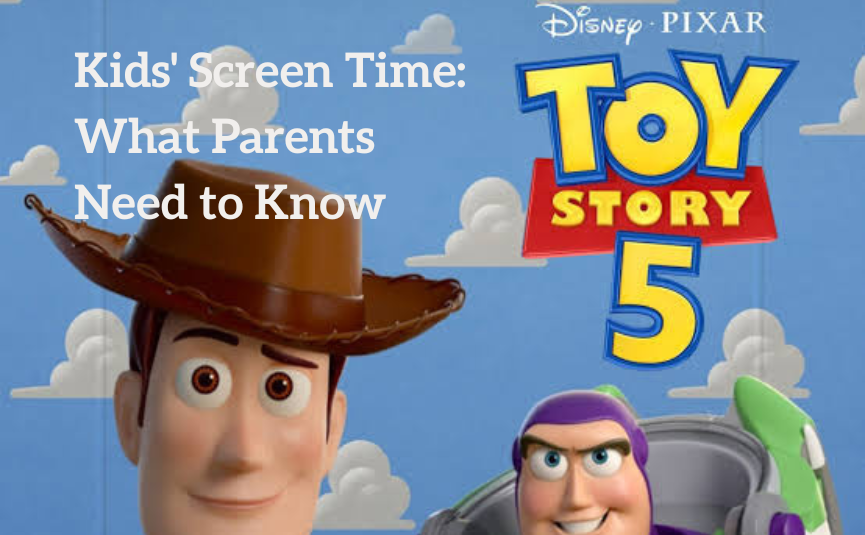
Pixar’s latest film isn’t really about toys or technology. It’s about protecting the imagination, connection and play that help children flourish.
For nearly 30 years, Toy Story has been about growing up, friendship and imagination. But Toy Story 5 introduces a new character that many families know all too well: a tablet.
Without giving away too many spoilers, Bonnie receives a device to help her fit in with her peers. What follows is a story that many parents may recognise. Imaginative play begins to fade. Time with toys is replaced by time on a screen. Friendships become more complicated. And the adults around her struggle to notice just how much has changed.
While it is still an entertaining family film, Toy Story 5 also opens the door to some of the most important conversations parents can have with their children about technology.
The film doesn’t provide all the answers. But it does ask some very worthwhile questions.
The real battle isn’t toys versus technology
It would be easy to walk away thinking the movie is saying that screens are bad and toys are good.
The message is actually more nuanced than that.
Technology isn’t presented as the villain. Instead, the film highlights something many families experience every day. When technology becomes the default, it can quietly replace the very things children need most for healthy development.
Not because children don’t love playing outside.
Not because they have stopped being creative.
But because well designed technology competes incredibly well for their attention.
At Screen Sanity, we often remind parents that digital health isn’t about eliminating technology. It’s about making sure technology doesn’t crowd out the experiences that help children flourish.
Imaginative play is doing more than we realise
Watching Bonnie lose interest in her toys is emotional because toys have always represented something much bigger.
When children invent stories with dolls, LEGO, cars or dinosaurs, they are doing important developmental work.
They are:
- Practising problem solving.
- Learning empathy through pretend play.
- Building language.
- Developing creativity.
- Learning to tolerate boredom.
- Growing their attention span.
Research consistently shows that open ended imaginative play supports cognitive, emotional and social development in ways passive entertainment cannot.
This doesn’t mean every minute needs to be spent building cubby houses or dressing up as pirates.
It simply reminds us that childhood needs space for imagination.
Because imagination cannot be downloaded.
One of the hardest scenes isn’t about Bonnie
Perhaps one of the most uncomfortable parts of the film isn’t Bonnie at all.
It’s the adults.
Throughout the story, Bonnie’s parents are often distracted by their own devices, juggling work, messages and video calls while gradually missing the changes happening in front of them.
Many parents will recognise this.
Not because we’re bad parents.
Because modern life constantly pulls at our attention.
At Screen Sanity, we believe one of the most powerful ways to shape our children’s relationship with technology is to start with ourselves.
Children don’t simply listen to what we say.
They watch how we live.
When they regularly see us putting our phones away during dinner, listening without distraction or choosing a family walk over scrolling, they learn what healthy digital habits look like.
Fitting in has never been more complicated
One of the film’s most relatable moments is Bonnie wanting the device because everyone else has one.
That pressure feels very familiar.
Many Australian parents tell us they worry their child will miss out socially if they delay giving them a smartphone or tablet.
The truth is that fitting in has always mattered to children.
Technology has simply become one more way children measure belonging.
That doesn’t mean parents should rush to keep up.
Often, the greatest gift we can give children is confidence that they don’t need every device simply because everyone else has one.
Values, family culture and strong relationships remain far more influential than following every trend.
Where we see things a little differently
One part of the film left us wanting a stronger message.
Without revealing too much, the story ultimately suggests the device becomes part of the solution.
We appreciate the film’s attempt to avoid oversimplifying technology into “good” or “bad.” Life is rarely that black and white.
But we also believe parents have more influence than the movie sometimes suggests.
Technology is not inevitable.
Families still have choices.
Children don’t need unrestricted access simply because others have it.
Parents can delay devices.
They can create healthy rhythms.
They can protect childhood for a little longer.
And those decisions matter.
Three questions to ask after watching together
Rather than treating Toy Story 5 as simply another movie night, use it as an opportunity to start a conversation.
You could ask:
- What changed in Bonnie after she got the tablet?
- What kinds of play make you feel happiest?
- How can our family make more room for imagination and connection this week?
There are no perfect answers.
The goal is simply to keep the conversation going.
Childhood is still worth protecting
The biggest takeaway from Toy Story 5 isn’t that technology is the enemy.
It’s that childhood is precious.
Children need time to imagine.
To get bored.
To build forts.
To invent games.
To make mistakes with real people instead of perfect algorithms.
Technology will always be part of their future.
Childhood only happens once.
At Screen Sanity, we believe parents don’t have to choose between embracing technology and protecting childhood.
With intentional choices, healthy boundaries and meaningful connection, families can enjoy the benefits of technology without allowing it to replace the moments children will remember most.
Because in the end, the real story isn’t about toys.
It’s about making sure our children remain captivated by life, not screens.