
At Screen Sanity, we use five simple digital health principles to help families make thoughtful, sustainable decisions with technology.
We call it START:
Start with Yourself – Children notice our habits before they follow our rules.
Tables and Bedtimes – Some of the healthiest screen boundaries begin with where devices are and are not allowed.
Accountability – Children need guardrails, not just access.
Ride. Practice. Drive. – Technology works best when freedom is introduced slowly and intentionally.
Time Well Spent – The goal is not less life on screens. It is more life beyond them.
These principles give families a practical framework for building digital health at home, without needing to overhaul everything at once.
In this blog, we are focusing on two of the most practical and protective places to begin:Tables and Bedtimes and Accountability.
Because one of the most important digital health decisions a family can make has nothing to do with software. It is where devices sleep.
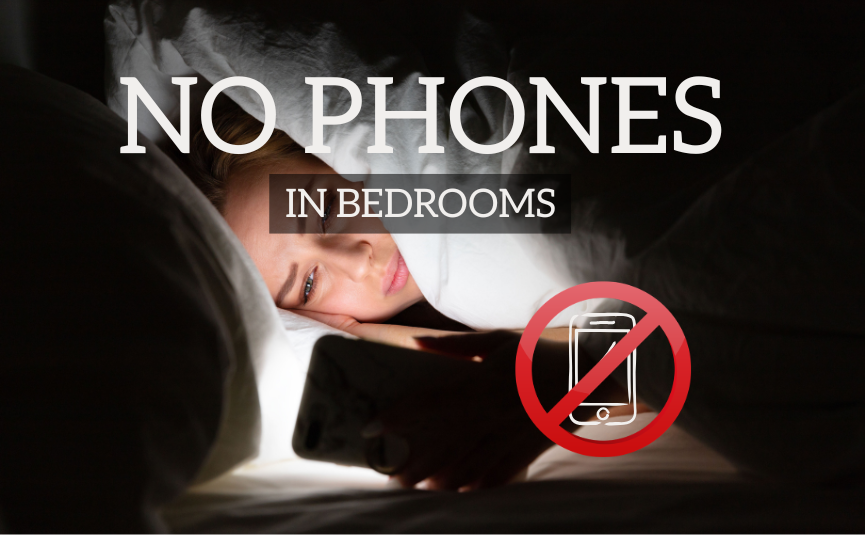
A simple boundary like keeping devices out of bedrooms is one of the most effective ways to reduce risk, improve sleep, and create the kind of accountability children still need while they are learning to navigate the online world.
Why bedrooms matter
There is no internet filter that can fully protect a child online.
That is not fear talking. It is reality. Even the best tools have limits, and every parent eventually learns the same thing: there is no single setting, app, or parental control that can do the job for us.
That is why one of the most effective digital boundaries has nothing to do with software.
It is keeping devices out of bedrooms.
Bedrooms are private, quiet, and unsupervised. In the digital world, those are the exact conditions where problems escalate quickly.
When children are alone, tired, and behind closed doors, their impulse control is lower. They are more likely to keep scrolling, stay up too late, take risks, or respond to things they would handle differently in the light of day.
This is not just instinct. Research backs it up.
- 69% of teens take their phones to bed and 29% sleep with them in bed. Robb, M. B. (2019). The New Normal: Parents, Teens, Screens, and Sleep in the United States. Common Sense Media, p. 40. https://www.commonsensemedia.org/sites/default/files/research/report/2019-new-normal-parents-teens-screens-and-sleep-united-states-report.pdf
- 36% of teens are woken by notifications during the night. Robb, M. B. (2019). The New Normal: Parents, Teens, Screens, and Sleep in the United States. Common Sense Media, pp. 25–27. https://www.commonsensemedia.org/sites/default/files/research/report/2019-new-normal-parents-teens-screens-and-sleep-united-states-reportf.pd
- Smartphone activity overnight is increasingly common among young people, with Common Sense Media research finding that 60% of 11 to 17 year olds were active on their phones between midnight and 5am on school nights. Common Sense Media. (2023). A week in the life of a young person’s smartphone use. Common Sense Media. https://www.commonsensemedia.org/sites/default/files/research/report/2023-cs-smartphone-research-report_final-for-web.pdf
That matters because sleep is not just rest. It is when children regulate mood, consolidate learning, process emotion, and restore cognitive control.
When sleep is disrupted, so is everything that depends on it.
The real risk is not just content. It is condition.
Most parents think about online risk in terms of content.
Pornography. Predators. Group chats. Social pressure.
Those risks matter. But often what makes them more dangerous is the condition in which they happen.
Late at night. Alone. Tired. Without adult support.
The part of the brain responsible for judgment, planning, and self control, the prefrontal cortex, is still developing well into a child’s twenties. Young people are already more likely to act quickly, respond emotionally, and take risks when something feels urgent or socially charged. At night, that vulnerability increases.
That is when children are most likely to:
- keep scrolling long past exhaustion
- respond impulsively
- engage in risky conversations
- absorb content they are not equipped to process
- carry emotional pressure they should never be holding alone
A phone in the bedroom is not just a device. It is unrestricted access to the internet at the exact time children are least equipped to navigate it well.
The goal is not control. It is accountability.
When we talk about boundaries with screens, it is easy to assume the goal is control.
It is not.
The goal is accountability.
Children are not meant to navigate the digital world alone. They need support, guardrails, and time to build the judgment required to carry more freedom well.
In the Screen Sanity Handbook, we compare this to a seatbelt.
A seatbelt does not prevent every accident, but it adds an important layer of protection when something goes wrong. Digital accountability works the same way. It does not remove all risk, but it helps reduce harm and creates opportunities for support when children need it most.
Start with the environment
The safest and simplest place to begin is not with an app.
It is with the home.
Before you add more software, start by changing the environment around the device.
That means:
- No devices in bedrooms
- A shared family charging station overnight
- Devices used in common spaces where possible
- Clear expectations around sleepovers, playdates, and late night messaging
- Open conversations about what to do when something uncomfortable shows up online
This is the first and most important layer of protection because it creates natural accountability without relying on constant surveillance.
Technology can support safer digital habits, but it works best when it is used as one layer of protection, not the whole plan.
The Screen Sanity Handbook recommends a layered approach.
First layer: router level filtering
This is your home’s first line of defence.
Router level filters help reduce exposure to explicit or harmful content across every device connected to your home wifi. These tools work quietly in the background and can help keep the most concerning content out of everyday searches.
Recommended tools:
These tools are not perfect, but they are a helpful first layer.
Second layer: device level filtering and monitoring
Once a device leaves your home wifi, router filters no longer apply.
That is where device level tools come in.
Platforms like Qustodio, Bark, and Canopy can help parents monitor risk by flagging harmful content, scanning messages, and alerting parents to concerning activity across texts, apps, and social feeds.
Used well, these tools are not about spying.
They are about support, visibility, and staying connected to what children may not yet know how to navigate alone.
Third layer: relationship
This is the layer that matters most.
No filter can replace trust.
No app can replace conversation.
No monitoring tool can replace a child knowing they can come to you when something goes wrong.
The most important safeguard in your home is not software.
It is a child who knows they can say, “Something happened,” and be met with calm, steady support.
This is why the Screen Sanity Handbook encourages parents to practise their “I’m not shocked” face.
Tell me more. I’m listening.
That response matters more than any app ever will.
One small change that matters tonight
If you are not sure where to begin, begin here.
- Move devices out of bedrooms tonight.
- Set up a shared charging space. Plug in together.
It is a small change, but it creates more sleep, more safety, and more space for children to be kids.
And in a digital world that asks too much of them too early, that is no small thing.
If you would like to dive deeper you can find more detail in the Screen Sanity Handbook.